
Currencies and exchange rate calculation is one of the most advantageous features in Konsolidator. In this article, we have described the calculation methods, the accounting principles, and pitfalls or considerations that you need to be aware of. The article covers the following areas:
-
Accounting standards
- Direct method versus step-by-step method
-
Exchange rates applied
- Profit/loss accounts
- Balance sheet
- Equity
i. Changes in equity during the year ii. Recirculation of currency adjustments - Cash Flow
-
Changes in Group Structure
- Acquiring a subsidiary
- Disposing of a subsidiary
- Intercompany restructuring
1. Accounting standards
Konsolidator's exchange rate translation follows IFRS standards.
IAS 21 The effects of changes in foreign exchange rates is the standard in which Konsolidator translates the profit/loss accounts, balance sheet accounts, and cash flow accounts.
First, the functional currency needs to be defined. In Konsolidator the functional currency corresponds to the currency set in the group structure for each company. For the parent company, the functional currency is also the presentation currency.
Konsolidator's calculation methods are based on the IFRS standard and to determine the exchange rates used in Konsolidator the following two sections are used:
IAS 21.21 states A foreign currency transaction shall be recorded, on initial recognition in the functional currency, by applying to the foreign currency amount the spot exchange rate between the functional currency and the foreign currency at the date of the transaction.
Further IAS 21.22 on the practical approach to determining the exchange rate For practical reasons, a rate that approximates the actual rate at the date of the transaction is often used, for example, an average rate for a week or a month might be used for all transactions in each foreign currency occurring during that period.
Earlier IFRS looked at currency translation according to a temporal method (historical) or a current method. Konsolidator uses the current method when doing currency translation. If the consolidation requires a temporal method to be used a manual journal would need to be prepared.
1.a. Direct method versus step-by-step method
Translating for consolidation purposes can be done using either the direct method or the step-by-step method. The established accounting practices are mentioned in IFRIC 16.16. Direct method where all subsidiaries are calculated directly into the functional currency of the ultimate parent company. The other method is a step-by-step method where the foreign entity is translated into the functional currency of the intermediate parent and then translated into the functional currency of the next intermediate parent all the way up to the ultimate parent company.
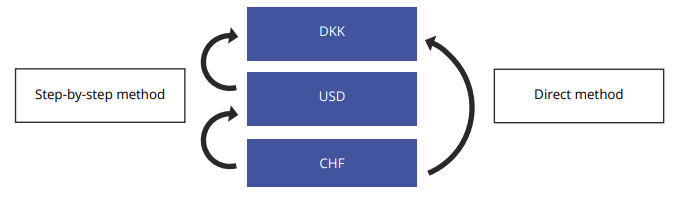
Konsolidator is using the step-by-step method. This also means that the lowest level of consolidation needs to be prepared before consolidating the next level in the group structure.
2. Exchange rates applied
Konsolidator contains all monthly average and period-end rates for all currencies needed. The data is received from the European Central Bank (ECB). If the currency is not traded by ECB, the exchange rate information comes from Investing.com. All exchange rates in Konsolidator are calculated using USD as the common denominator.
The average rate is calculated by taking all the daily end rates during the month and calculating an average of these. The end rate is the end rate on the last trading day in the month.
In theory and according to IFRS the exchange rate on the transaction date is to be used on all transactions. In most cases, this is impossible to use (see section 1). To get a standardized approach consolidation by consolidation the monthly average, calculated as described above, is used by Konsolidator. It is possible to use your own exchange rates by typing the exchange rate into Konsolidator.
2.a. Profit and loss accounts
In the profit/loss accounts Konsolidator uses an average rate. The average rate will be applied for the movement from the last consolidation done in Konsolidator to the current period on all profit/loss accounts. For example, if a group consolidates quarterly, Konsolidator will go back to the latest quarterly consolidation and calculate the movement for the quarter by subtracting the previous consolidation from the current. This leads to a weighted average currency translation on each single group account in Konsolidator which is shown in appendix 1 where an example of the weighted average currency translation is illustrated.
In Appendix 1 the translation occurs each month at the monthly average rate and then adding the translated.
YTD number from the previous period. This is different from using a method of applying the average rate for January - March (77.00). Applying this rate would lead to group sales of (500*770/100) EUR 385. The reason for using a weighted average method when translating the income statement (and not the method where a group each month uses a new average for the entire financial year) is that the weighted average is more accurate according to IFRS as well as it takes any seasonality and changes in FX rates into consideration on a monthly basis. Another reason for using the weighted average method is when using a new average rate for the entire period every month then previous periods are recalculated using a different exchange rate, which we believe not to be correct.
A consequence of the weighted average method is that if sales are USD 100 in January and an issue of a credit note of USD 100 in February. Sales YTD in USD will be 0. However, this will lead to EUR 10 in sales for the group because of different exchange rates when the transaction occurs even though sales in local currency are zero.
2.b. Balance sheet
Konsolidator translates all balance sheet accounts into the exchange rate at the end of the period and from there Konsolidator has set up automatically calculated journals to provide the correct presentation of the FX effects in fixed assets as well as in equity. For fixed assets, Konsolidator translates the opening cost and accumulated depreciation at the beginning of the year to match last year's closing balance (current method) as well as translating the different movements (excluding revaluations) in fixed assets to a weighted average and then being able to match the depreciation in the income statement with the depreciation for the year in the fixed assets. For the FX effects in the equity see the section below.
Konsolidator does not use the temporal method where the historic exchange rate for translation is used. Konsolidator gives you the possibility to calculate the correct note information for fixed assets. Meaning that if the subsidiary prepares their correct note information on group account level in their financial numbers (begin- ning amounts, movements, etc. for the year) Konsolidator calculates the beginning amount to the exchange rate at the end of last year and all movements for example additions and the depreciation for the year will be calculated using the weighted average translation which is used in the profit/loss accounts.
2.2. Equity
The equity is as other balance sheet accounts translated using the end rate for the period. Konsolidator automatically prepares journals that correctly present the exchange rate adjustments for each subsidiary and subgroup.
Exchange rate adjustments in the profit/loss calculate the difference from the average to the end rate. Since the current year profit/loss at first is translated using the end rate, Konsolidator prepares an elimination journal that transfers an FX adjustment from the current year's profit/loss to FX adjustments in the equity. The journal ensures that the current year's profit/loss in the equity is the same as the translated profit/loss in the income statement. The same applies to the non-controlling interests in equity.
Exchange rate adjustments on the beginning equity are prepared as an elimination journal in Konsolidator when using the cost method and as an adjusting journal entry when using the equity method. The difference in equity using the exchange rate at the beginning of the year and the exchange rate at the end of the period is booked as an FX adjustment in equity as part of the reserve for exchange rate adjustments. The same applies to the non-controlling interests in equity.
For more in-depth guidance on the journals see separate articles on journals.
2.c.i. Changes to equity during the year
It is not possible for Konsolidator to calculate any FX adjustments on any changes to equity during the year besides the above. For instance, if a subsidiary has paid dividends during the year or has had a capital increase during the year then the FX adjustments need to be calculated and booked manually. Konsolidator does not have the exchange rate on the date of the transfer of funds and therefore it is not possible for Konsolidator to calculate the FX adjustment. The calculation must be done for the entire current financial year.
2.c.ii. Recirculation of Currency Translation Adjustments (CTA)
When a company is sold or for other circumstances is no longer part of the group the accumulated currency translation adjustment for the entity should be recirculated from the equity to the profit/loss.
The amount for recirculation can be found in Konsolidator. For each consolidated period, Konsolidator calculates the year-to-date currency translation adjustment per consolidated company and posts it to equity. Meaning that in the journals in the last month of your financial year you can see the relevant amount for each consolidated company for that specific year. The adjustment would be part of the equity at the beginning of the next year where Konsolidator then posts the exchange rate adjustment for the new year.
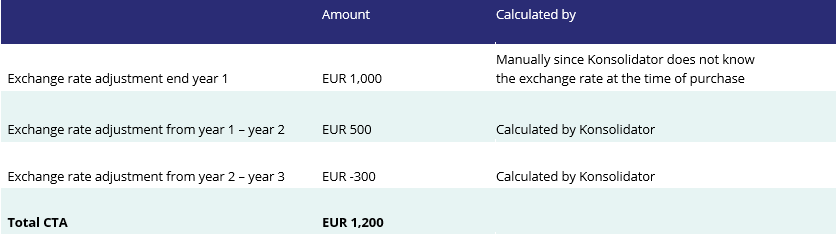
For example, a company is purchased with functional currency USD and the group's presentation currency is EUR. The exchange rate at purchase is 70, the exchange rate end of year one is 80, year two is 85, and year three is 82. The equity is always USD 10,000.
2.d. Cash flow
As with the currency translation in the profit/loss, Konsolidator uses the average FX rate when translating from local currency to group currency for cash flows. The average rate will be applied for the movement from the last cash flow consolidation done in Konsolidator to the current period on all cash flow accounts. This is according
to IAS 7.27 which states: Cash flows denominated in a foreign currency are reported in a manner consistent with IAS 21 The Effects of Changes in Foreign Exchange Rates. This permits the use of an exchange rate that approximates the actual rate. For example, a weighted average exchange rate for a period may be used for recording foreign currency transactions or the translation of the cash flows of a foreign subsidiary. However, IAS 21 does not permit the use of the exchange rate at the end of the reporting period when translating the cash flows of a foreign subsidiary.
Konsolidator calculates cash flows for each company in local currency and then consolidates to group currency. This means that if no movements in the balance sheet or P/L are made in the company, it will not lead to a cash flow in the consolidated numbers. This is according to IAS 7.28 which states Unrealised gains and losses arising from changes in foreign currency exchange rates are not cash flows. However, the effect of exchange rate changes on cash and cash equivalents held or due in a foreign currency is reported in the statement of cash flows in order to reconcile cash and cash equivalents at the beginning and the end of the period. This amount is presented separately from cash flows from operating, investing, and financing activities and includes the differences, if any, had those cash flows been reported at end-of-period exchange rates. Konsolidator specifies the FX adjustments for cash and cash equivalents into the following:
- the exchange rate difference from the movements to the average rate into the end rate
- the difference from cash at the beginning of the year with the rate from then to the rate at the end of the reporting period
By applying this methodology there is no currency translation besides the two mentioned above.
3. Changes in group structure
During the financial year, a group can have different kinds of changes to its group structure. When that happens, the group needs to be aware of how the currency translation should be handled and know how it is handled in Konsolidator.
3.a. Acquiring a subsidiary
When acquiring a subsidiary be aware that in the group structure to set the consolidation date correct. Acquiring a company mid-year for example July 1, the YTD trial balance is uploaded on July 31 and a manual prepared journal is booked in order only to have July numbers in the consolidation. Konsolidator will translate P/L according to the above as well as the balance sheet.
For the cash flow statement, the translation is also as above. Be aware that there are no numbers at the beginning of the year since the subsidiary was not owned and a cash flow adjusting journal needs to be prepared where the purchased balance is booked in order to only get the adjustment for July. Regarding cash, the currency translation will use the difference between June end exchange rate and July end exchange rate.
3.b. Disposing of a subsidiary
When disposing of a subsidiary, it is important that for the remainder of the financial year an upload is made each period. The upload should only include the P/L and a posting to equity to balance the upload. The uploaded numbers should be the same as the previous month when the subsidiary was owned by the group. When translating the next month after disposal the movement will be zero and thus no translation effect.
3.c. Intercompany restructuring
When a group performs intercompany restructures, there are some things to be aware of regarding currency translation. It is important that a new company is created in the group structure and not change the parent company of the current company. Doing so could create other issues regarding the consolidation and the data tables in the database.
After the restructure, the upload should be to the newly created company, and nothing should be uploaded to the old company. The currency translation for the newly created company will be that the YTD numbers in the P/L accounts will be translated to the monthly average rate. This is not correct since it should only be the current month. However, for the old company where nothing has been uploaded a translation will be done since the movements for the current month are corresponding to the opposite of the previous upload and thus creating a translation that goes opposite to the translation for the newly created company. At the ultimate parent, the two numbers will be added in the consolidation and the translation will be correct. For the new and the old company, the numbers will not be correct on a stand-alone basis.
Indsæt file