
This article is for you using the accounting principle "equity method". The purpose is to give you a detailed understanding of how Konsolidator® calculates the three adjusting journal entries (AJE) and two elimination journal entries.
Selecting your accounting principle
You can use two different accounting principles in Konsolidator: Equity method and Cost method. You choose the principle in the setup and adjust it in your group structure. If you are in doubt about your accounting principle, you can always contact us in support at support@konsolidator.com
The five system journal entries the article covers are:
Adjusting Journal Entries (Entity level – parent company)
- Journal entry: Income from group subsidiaries
- Journal entry: Exchange rate adjustments – net income
- Journal entry: Exchange rate adjustments – equity
Elimination of Journal Entries (Group level)
- Journal entry: Elimination of income from subsidiaries
- Journal entry: Elimination of investments in subsidiaries
You must post the elimination journal entries for all subgroups. The reason is that Konsolidator® calculates the elimination journal entries on all group levels and uses a bottom-up consolidation.
System journals
The journal entries we cover in this article are system journals, meaning they cannot be edited and will change every time you press "CALCULATE & POST".
Bottom-up Consolidation
Each consolidation starts with the lowest level of the group and goes up, finishing with the ultimate parent company. See the image below of bottom-up consolidation.
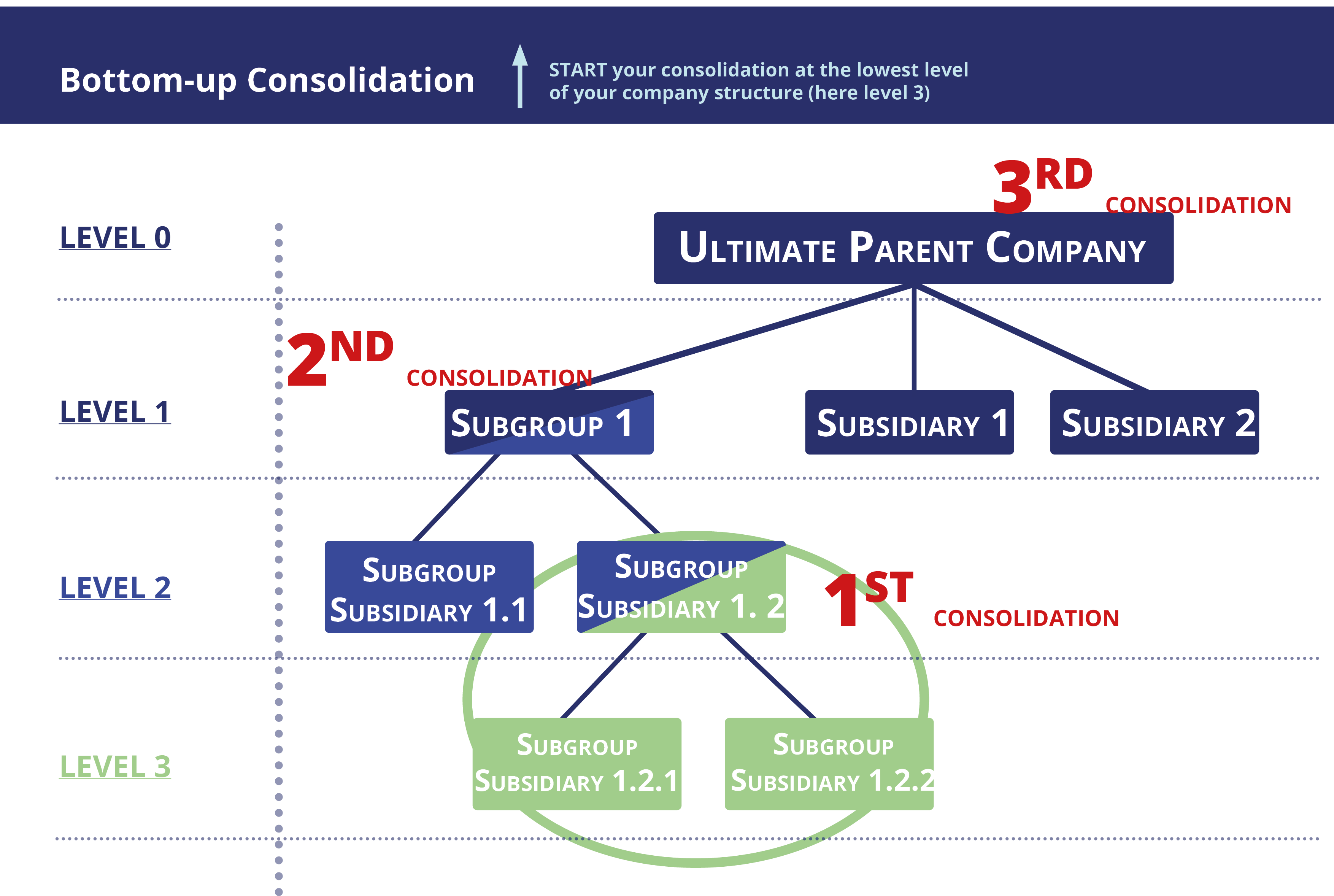
NB: Remember to consolidate chronologically due to the currency translation (e.g., January, February, etc.).
Excel example of Konsolidator®'s calculations:
Click on the link below for an Excel example, which can help clarify how the numbers are calculated - when you go through the article. Appendix_How system journals are calculated_Equity.xlsx
Adjusting Journal Entries (Entity level – parent company)
If you use the accounting principle "equity method," Konsolidator® calculates and posts adjusting journal entries (AJE) for the parent company. The equity method ensures that the AJE for the parent company includes the parent's income from the subsidiaries in the profit/loss and, at the same time, prepares their exchange rate adjustments regarding the subsidiaries.
There are three adjusting journal entries:
- Journal entry: Income from group subsidiaries
- Journal entry: Exchange rate adjustments – net income
- Journal entry: Exchange rate adjustments – equity
Note:
Do not post these adjusting journal entries in Konsolidator® if they are already part of the uploaded trial balance for the parent company. However, we recommend using Konsolidator® to calculate and post these numbers so that you can track and minimize the risk of errors. By doing these AJEs manually, you risk:
- Non-trackable data
- Errors in calculations
- Numbers do not add up in the reports
How to deselect journal entries if you do not have foreign subsidiaries:
If you keep these numbers in the parent company's bookkeeping, you can deselect the journal entries so that Konsolidator® does not calculate and post the numbers twice.
Press "CALCULATE & POST" in the Journals menu, and deselect the three journal entries in the pop-up box (shown below).
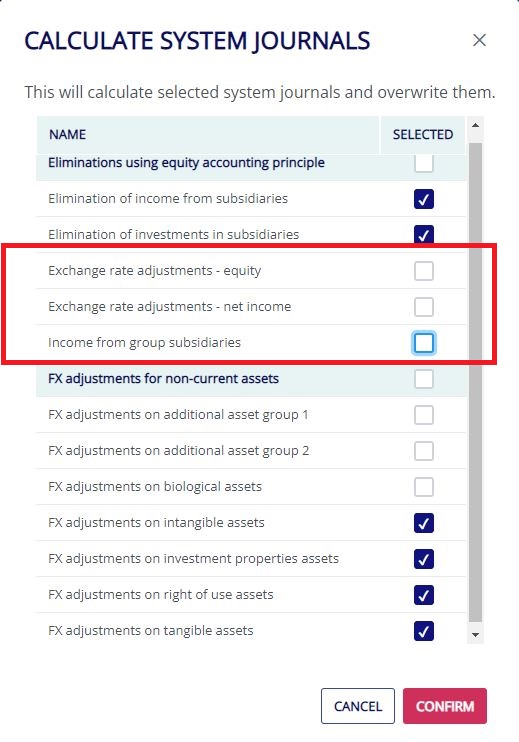
Now, these adjustments will not be visible in the consolidation report but are still part of the parent entity's final numbers before consolidation. Since AJEs are based on the entity level, these adjustments will appear in separate columns in the upload report.
1. Journal entry: Income from group subsidiaries
This journal entry calculates the parent company's share of the profit/loss for each subsidiary and subgroup. The journal entry prepares and posts the parent company's share of the profit/loss for each subsidiary and subgroup to the profit/loss statement and investments in subsidiaries under assets on the balance sheet. These numbers will be eliminated in the journal entry: "Elimination of income from subsidiaries", described later in this article.
Reading the journal entry:
Below you can see a picture of the journal entry in Konsolidator®. This journal entry always balances.
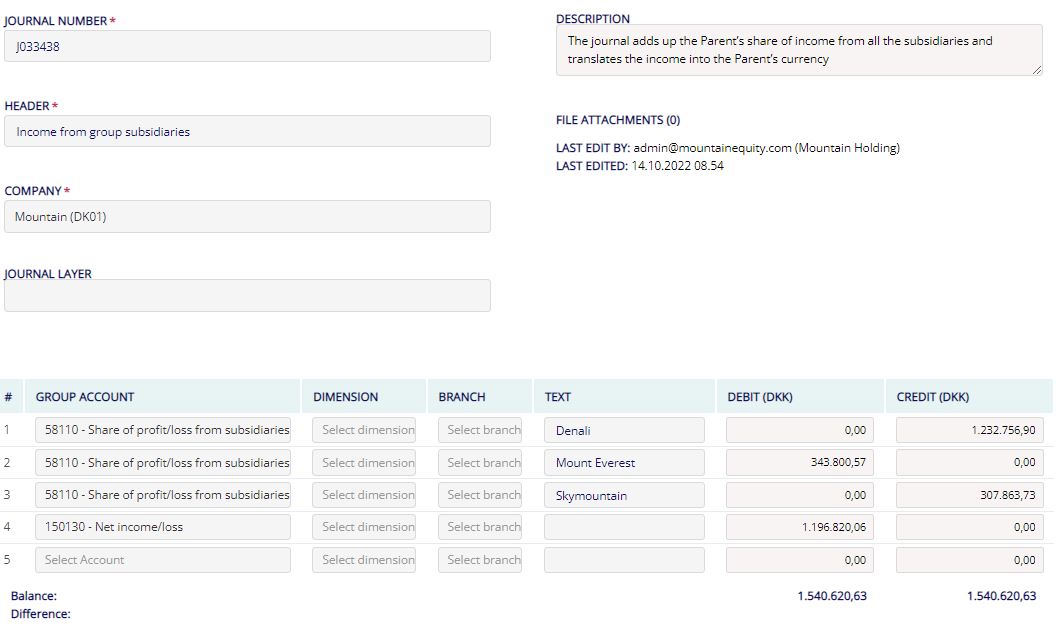
Rows 1-3 show the share of profit/loss for each subsidiary/subgroup owned by the parent company.
Row 4 posts the total share of profit/loss to an asset account included in investments in subsidiaries.
Konsolidator®'s calculations explained:
Konsolidator® calculates the share of profit/loss using the uploaded numbers for each subsidiary or the consolidated numbers for the subgroup and multiplying the numbers by the ownership percentage. For Konsolidator® to be able to calculate using different ownership percentages correctly, Konsolidator® draw data from the previous consolidation to calculate profit/loss for the period between the previous and the current consolidation.
Changing ownership percentage during the year
Konsolidator® includes ongoing changes to ownership percentage during the year. For example, if the ownership interest changes from 80 % to 90 % from one month to the next, Konsolidator® will adhere and use 80 % for the first month and 90 % for the next when calculating the share of profit/loss.
You can change the ownership percentage in the setup under group structure.
Following the calculation of the share of profit/loss, Konsolidator® translates the local currency to group currency using the average exchange rate for the current month. You can find information about currency translation here
2. Journal entry: Exchange rate adjustments – net income
This journal entry calculates the net income's exchange rate adjustments going from the average rate to the period-end rate. The average rate is used for translating profit/loss, and the period-end rate is used for translating the balance sheet. To get the equity in the subsidiary to balance the parent company's investment in subsidiaries, Konsolidator® calculates an exchange rate adjustment from average to period end. The journal entry contains the exchange rate adjustment for each subsidiary/subgroup.
Note:
Find the calculation of the exchange rate adjustment for the non-controlling interests in the journal entry "Elimination of investments in subsidiaries".
Reading the journal entry:
Below you can see a picture of the journal entry in Konsolidator®. This journal entry always balances.
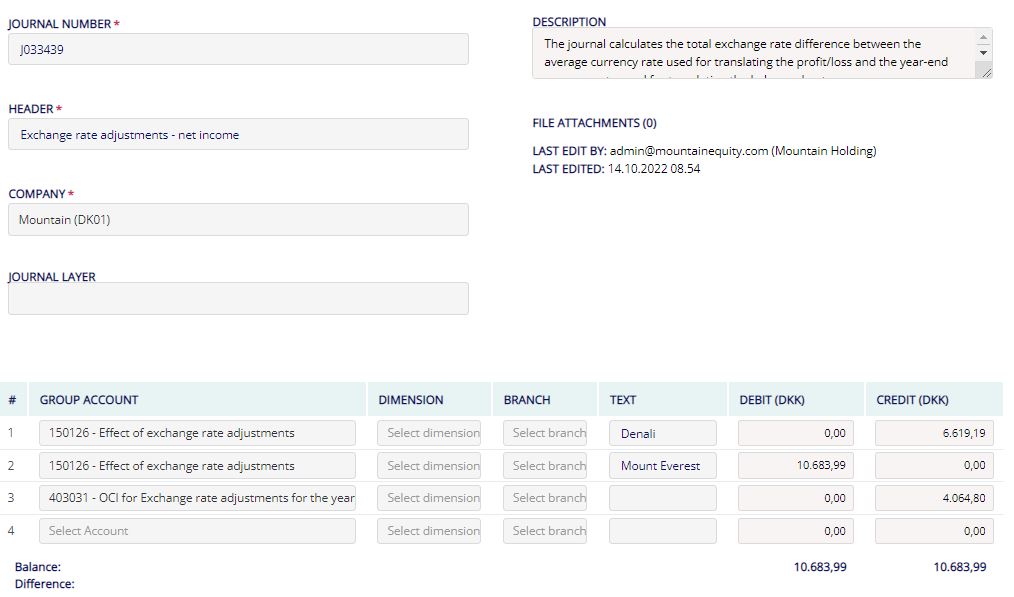
Rows 1-2 show the calculated exchange rate adjustment identified for each subsidiary/subgroup and post the exchange rate to the asset account "Investments in subsidiaries".
Row 3 posts the exchange rate adjustments to the "Exchange Rate Adjustment in the equity" account.
Konsolidator®'s calculations explained:
The investment in subsidiaries (asset account) must be translated using a period-end exchange rate. This journal entry calculates the exchange rate adjustments by applying the average currency rate for translating the profit/loss and the year-end currency rate for translating the balance sheet.
To calculate the exchange rate adjustments for net income, Konsolidator®:
- Translates profit/loss for the period using a weighted average exchange rate.
- Translates the “Profit/loss – current year” account in equity using a period-end exchange rate.
- The difference between these two translations is your currency adjustment for the net income.
Konsolidator® translates the income statement using a weighted average method and takes the ownership percentage into account.
3. Journal entry: Exchange rate adjustments - Equity
This journal entry calculates the exchange rate difference between the currency rate used for equity at year-end for the previous financial year and the period-end currency rate for the current financial year. Konsolidator®calculates the exchange rate adjustment for each subsidiary and subgroup and posts it in investments of subsidiaries and equity. The journal includes the ownership percentage from the previous financial year-end when calculating the exchange rate adjustments.
Note:
Find the calculation of the exchange rate adjustment for the non-controlling interests in the journal entry "Elimination of investments in subsidiaries".
Reading the journal entry:
Below you can see a picture of the journal entry in Konsolidator®. This journal entry always balances.
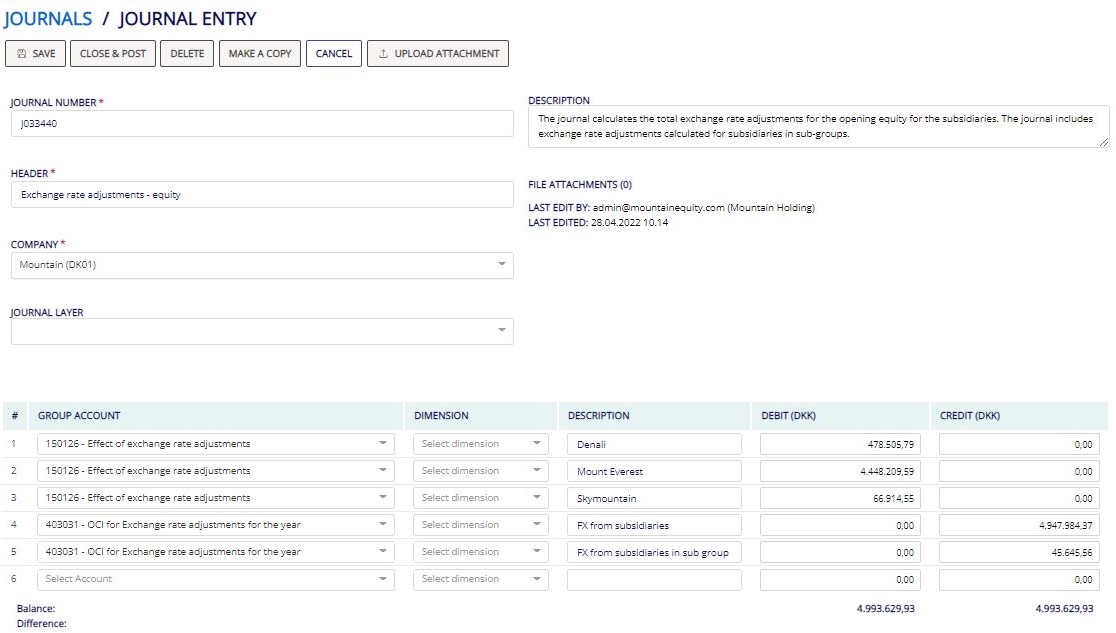
Rows 1-3 show the calculated exchange rate adjustment identified for each subsidiary/subgroup. Konsolidator® posts the exchange rate to the asset account in investment in subsidiaries.
Rows 4-5 post the exchange rate adjustments to equity and divides the postings between adjustments from subsidiaries and adjustments from subsidiaries in subgroups.
Konsolidator®'s calculations explained:
Each subsidiary's equity must balance with the parent company's investment in each subsidiary.
Konsolidator® calculates an exchange rate adjustment for the opening equity. The opening equity used for calculating the journal entry is from the year-end consolidation from the previous financial year. The journal entry calculates the difference between the period-end and year-end exchange rates multiplied by the opening equity. Further, the journal entry posts exchange rate adjustments from subgroups looking at the subgroup's exchange rate adjustments and the ownership percentage of the subgroup.
Cumulative translation adjustment
When preparing the journal entry at the beginning of the year, we recommend you re-classify each entity's cumulative translation adjustment (CTA). You can do this in the Group account “Exchange Rate Adjustment at the beginning of the year” from the group account “Retained Earnings at the beginning of the year”.
Since the exchange rate adjustment journal entries calculate the current year’s translation adjustment - all prior years’ accumulated adjustments need to be posted manually to the account for exchange rate adjustments at the beginning of the year. You must update the journal entry at the beginning of every financial year. If there is no other posting to equity during the year, then the CTA will be available in Konsolidator® for each subsidiary.
Be aware that Konsolidator® calculates exchange rate adjustments on profit/loss and opening equity. You will need to manually calculate and post the exchange rate adjustments if, e.g.:
- a dividend is paid
- a capital increase occurs during the year
- any new companies are acquired or established during the financial year.
You can do this by preparing a separate exchange rate adjustment journal entry for the remaining month of the financial year.
Elimination Journal Entries (group level)
Besides posting three adjusting journal entries, Konsolidator® also calculates and posts two elimination journal entries when you use the accounting principle "Equity method". These important journal entries are created on a group level and ensure your consolidation is correct.
The two elimination journals are:
- Elimination of income from subsidiaries
- Elimination of investments in subsidiaries
As mentioned at the beginning of the article, Konsolidator®'s consolidation method is bottom-up.
Konsolidator ensures that the result from the subsidiaries and subgroups is automatically shared between shareholders and minorities.
1. Journal entry: Elimination of income from subsidiaries
This journal entry eliminates all shares of profit from investments in subsidiaries and transfers the profit/loss between company shareholders and non-controlling interests.
The journal entry also calculates and transfers the consolidated profit/loss to shareholders of the company and the non-controlling interests. It identifies the transfer amount for each subsidiary and subgroup.
Note:
If you specify the profit share from subsidiaries in relevant accounts, then Konsolidator® automatically transfers the goodwill and internal profits on inventories to the “Goodwill amortization” account and the “COGS” account.
If you have manually prepared a purchase price allocation journal, then be aware that if you post the goodwill amortization in the parent group account, it will be posted twice.
Reading the journal entry:
Below you can see a picture of the journal entry in Konsolidator®. The journal will not always balance.
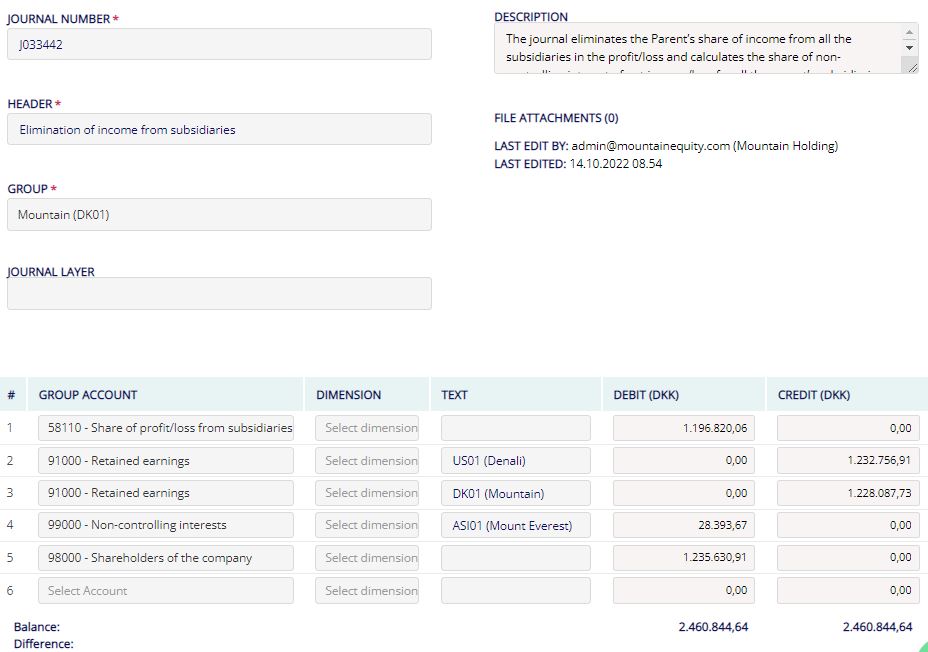
Row 1 zeros out the "Income from investments in subsidiaries" accounts.
Rows 2-3 post the elimination of the “Share of profit/loss for all subsidiaries” account against the “retained earnings” account.
Rows 4-5 split the profit/loss for the group between the “shareholders of the company” and the “non-controlling interests” accounts.
The text column shows what entity the profit/loss comes from.
The journal will not always balance, which can be due to the following reasons:
- If the parent company has booked the share of income from subsidiaries and has not used the calculations and adjusting journal entries that Konsolidator prepares.
- Or there can be an imbalance if the profit/loss in the subsidiaries does not match what has been manually booked in the parent company as the share of income from subsidiaries.
Further explanation of Konsolidator®'s calculations:
The journal entry transfers the calculated profit/loss using a weighted average method. You can find this in the "FX specification report". The software will transfer to shareholders of the company before transferring income to any non-controlling interest calculation.
When the group uses the same currency across all subsidiaries, you get the added benefit of error-checking your numbers by seeing if they match in the upload report.
You must post the journal entry in Konsolidator®
If you do not post the Journal entry, the consolidated profit/loss will not reconcile with the current year's profit/loss in equity for both shareholders of the company and the non-controlling interests, which will show in the validation report.
2. Journal entry: Elimination of investments in subsidiaries
This journal eliminates the parent's investment in subsidiaries against the subsidiaries' equity attributable to the company's owners by zeroing all the numbers in the accounts.
Reading the journal entry:
Below you can see a picture of the journal entry in Konsolidator®. The journal will not always balance.
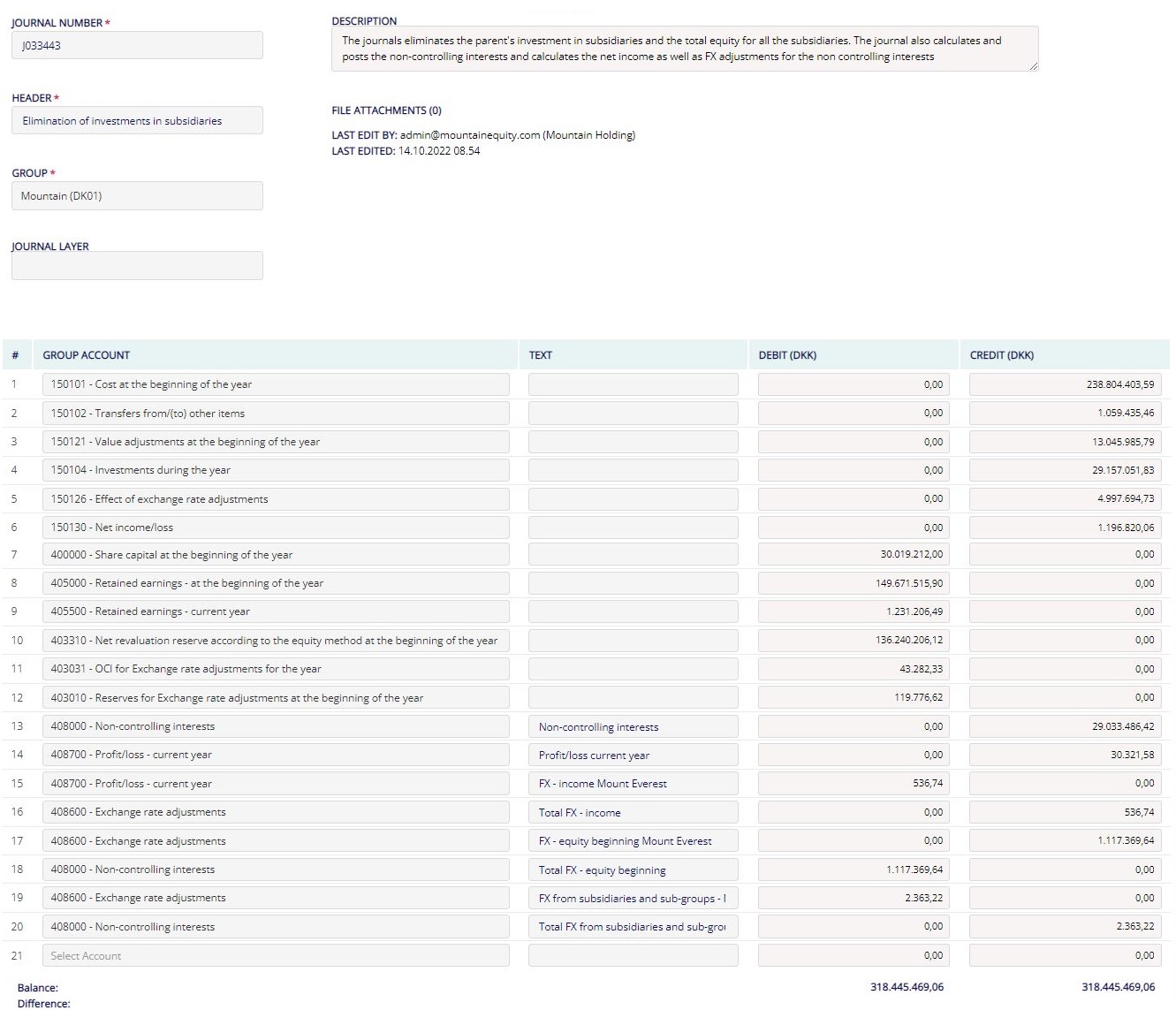
Rows 1-6 show the elimination of investments in subsidiaries for all accounts under assets. This is to zero out all numbers in the investments in subsidiaries for the parent company. Konsolidator® does not calculate anything.
Rows 7-12 zero out all numbers in all equity accounts for all subsidiaries/subgroups. Konsolidator® eliminates all equity accounts for subsidiaries (excluding accounts for non-controlling interests). Following the accounting principle, investments should equal equity. The journal entry balances if the parent company owns all subsidiaries 100 %, and there were no additional values (purchase price allocation) when the parent invested in the subsidiaries. Konsolidator® does not calculate anything but zero out the group accounts.
Rows 13-14 transfer the part of non-controlling interests from prior years from the equity of the shareholders of the company to non-controlling interests. It does not include the current period's net income and exchange rate adjustments.
Rows 15-20 are all calculated by Konsolidator® as follows:
- Rows 15-16 balance and translate each subsidiary's and subgroup's profit/loss for non-controlling interests from the exchange rate at period-end to the average exchange rate.
- Rows 17-18 balance and calculate the exchange rate adjustments for the beginning equity. This is done by taking the difference between the exchange rate from the period-end and subtracting the exchange rate from the previous year-end. Thereafter, the system multiplies this difference with the opening equity for the non-controlling interest of the prior year's consolidation.
- Rows 19 -20 balance and transfer the part of a subgroup's exchange rate adjustment calculated for that subgroup's subsidiary. The software calculates and posts an exchange rate adjustment in the subgroup if relevant. If the subgroup is not 100 % owned, this part of the journal entry transfers some of that exchange rate adjustment to non-controlling interests. The journal entry also transfers exchange rate adjustment from shareholders of the company to the non-controlling interests.
The journal will not always balance, which can be due to the following reasons:
- If purchase price allocation is not booked as an adjusting journal entry to the subsidiaries' accounts, then investments in subsidiaries will be higher than the subsidiaries' equity.
- If a subsidiary has booked a change in equity and the parent company has not booked this change in "Investment in subsidiaries", then the equity will be higher.
- If there are internal profits on inventory or other assets, there will always be a difference, and you should eliminate the internal profits manually.