
Please read the entire article before you start changing your group accounts.
This is a best practice example, and takes departure in an entity with no specified main business activity (MBA) and presents the income statement by nature.
Independent of which solutions you choose to implement IFRS 18, the Group Chart of Accounts (CoA) needs to change so that:
- IFRS 18 income statement categories are structurally enforced
- Operating profit and Earnings before financing and taxes are mandatory subtotals
- Foreign exchange differences are added to facilitate the categorization split
- Financial items are split into investment income and financing expenses
You can download standard Group CoA for the income statement, updated from IAS 1 to IFRS 18 here. The file includes an overview of all new accounts to be added.
Notice that all tables and accounts mentioned below are based on Konsolidator IFRS Standard Group CoA by nature. If your current Group CoA has been amended, the new Group CoA and new subtotals must be amended accordingly.
Step 1: Preserve IAS 1 group account structure
Before changing the group account structure, we recommend that you export the current Group CoA to Excel and make a mock-up of the changes in Excel for side-by-side comparison and afterwards implement it in Konsolidator. Further you will also have the current Group CoA preserved.
You go to Setup > Group Accounts and export to Excel. Note this will extract all group accounts including disabled/hidden accounts in your Excel spreadsheet. Save and label the file clearly for later reference, if needed.
Step 2: Establish the mandatory subtotals
As mentioned earlier in this article, the following two subtotals are mandatory under IFRS 18:
- Operating profit or loss and the
- Profit or loss before financing and income taxes
Find the article on how you edit a group account here and how you add new group accounts here.
First, the sum account 57999, currently named Profit/loss before financial items and tax (EBIT), should be renamed to the new mandatory subtotal Operating profit/loss. The account number remains the same. As IFRS 18 requires a split of the prior financial items into investing and financing categories, the current name of account 57999 requires an update.
Next, the new mandatory subtotal for Profit or loss before financing and income taxes shall be added. In our example we recommend adding the new subtotal with account number 59999. The related sum account of 59999 shall be 69999 Profit/loss before tax:
Table 1: New required subtotal added
| Group account | Group account name | Sum account |
| 59999 | Profit/loss before financing and tax | 69999 |
Step 3: Configure the Operating profit/loss
The following, highlighted, group accounts should be added under the operating profit:
Table 2: Operating category (Revenue & COGS) – new accounts
| Group account | Group account name | Sum account | Rationale |
| 11500 | External sales | 11999 | |
| 11800 | Intercompany sales | 11999 | |
| 11900 | Gain/loss on foreign exchange rates for receivables | 11999 | FX split required |
| 11999 | Revenue | 15999 | |
| 12100 | Change in inventories of finished goods, work in progress and goods for resale | 14999 | |
| 13100 | Own work capitalized | 14999 | |
| 14100 | Cost of goods sold | 14999 | |
| 14800 | Intercompany purchase | 14999 | |
| 14850 | Intercompany adjustments | 14999 | For Intercompany tolerances |
| 14900 | Gain/loss on foreign exchange rates for payables | 14999 | FX split required |
| 14999 | Cost of goods sold | 15999 |
Fair value adjustments
Under IFRS 18, the measurement of fair value adjustments remains unchanged. However, the presentation in the income statement is revised:
- Fair value adjustments on biological assets that form part of the entity’s operating activities are presented within the operating category, as they arise from the ongoing use of assets in the business.
- Fair value adjustments on investment properties and other investment assets, including gains or losses on disposal, are generally presented within the investing category, as they relate to returns from investments rather than the entity’s core operations.
An exception applies where the entity has a specified MBA of investing in assets. In such case, the fair value adjustments on investment properties are presented within operating profit.
Step 4: Configure the new Investing category
To configure the new investing category in the income statement, you need to add the investing income (mainly what is presented as financial income under IAS 1) and fair value adjustments of investments, if applicable.
It is important to establish the sum accounts (ending with 999) before the group accounts are added.
You can read more in our Kommunity about adding new subtotals here.
Table 3: Investing category – new accounts
| Group account | Group account name | Sum account |
| 58300 | Financial income from investments and receivables, which are non current assets | 58399 |
| 58310 | Financial income from Intercompany receivables | 58399 |
| 58320 | Interest income | 58399 |
| 58330 | Dividend income | 58399 |
| 58380 | Foreign exchange difference on cash and short-term deposits | 58399 |
| 58390 | Other investing income | 58399 |
| 58399 | Investing income | 59999 |
| 58400 | Gain from fair value adjustment of investment properties | 58499 |
| 58410 | Profit on sale of investment properties | 58499 |
| 58420 | Capital gains on investments | 58499 |
| 58499 | Gain on investments | 59999 |
| 58500 | Impairment loss of investment properties | 58599 |
| 58510 | Loss on sale of investment properties | 58599 |
| 58520 | Capital loss on investments | 58599 |
| 58530 | Impairment loss of other financial assets | 58599 |
| 58599 | Loss on investments | 59999 |
The above is not an exhausted list and should be adjusted as needed for the group and companies. If your group has specific requirements, we encourage you to add the accounts as needed to the relevant categories in the group accounts.
In our standard Group CoA under IAS 1, account 63000 Impairment losses of financial assets is presented under financial expenses. As the impairment loss of an (financial) asset, the loss will be related to an investment and as such to be presented as an expense under investing category.
Change of subtotals
With the new 59999 Profit or loss before financing and income taxes, the sum accounts above/before shall be updated to ensure they sum to the relevant subtotal. The accounts are updated as follows:
Table 4: Investing category – update the related sum accounts
| Group account | Group account name | Current sum account | New sum account |
| 57999 | Operating profit/loss | 68999 | 59999 |
| 58199 | Income from investments in subsidiaries | 58999 | 59999 |
| 58299 | Income from investments in associated companies | 58999 | 59999 |
With the changed sum account for subsidiaries and associated companies, account 58999 Income from investments in subsidiaries and associated companies, will become redundant and should be disabled.
Step 5: Configure the new Financing category
Most group accounts under IAS 1 presented as financial costs will also be presented as financing. Though, to ensure a smooth transition from IAS 1 to IFRS 18, including bridge adjustments, new accounts for financing should be created in the group accounts. It is important to emphasize the list below is not exhausted, and specific needs should be addressed by the group.
It is required to establish the sum accounts (ending with 999) before the group accounts are added.
Table 5 Financing category – new accounts
| Group account | Group account name | Sum account |
| 61000 | Interest expenses, intercompany liabilities | 61999 |
| 61100 | Interest expenses | 61999 |
| 61200 | Interest expenses, lease liabilities | 61999 |
| 61900 | Other financial expenses | 61999 |
| 63800 | Foreign exchange differences on interest-bearing loans and borrowings | 61999 |
| 61999 | Financing expenses | 69999 |
| 65000 | Fair value adjustment of mortgage debt | 65999 |
| 65200 | Profit/loss on financial debts | 65999 |
| 65999 | Financial debt adjustments | 69999 |
Step 6: Tagging IAS 1 related accounts
Once you have added and updated all new group accounts, some group accounts will only be relevant for IAS 1 reporting and should be tagged to ensure the group accounts for IAS 1 and IFRS 18 aren’t confused. We recommend using our tag functionality and name the tag “disable” or “IAS 1”.
You needd to tag the following accounts for next steps in our implementation solutions By structure or our implementation solution By new environment:
Table 7: Group accounts related to IAS 1 reporting only
| Group account | Group account name | Sum account |
| 58999 | Income from investments in subsidiaries and associates companies | 59999 |
| 62000 | Financial income from investments and receivables, which are non-current assets | 62999 |
| 62100 | Financial income from group companies | 62999 |
| 62200 | Interest income | 62999 |
| 62300 | Capital gains on investments | 62999 |
| 62400 | Dividend income | 62999 |
| 62500 | Gain on foreign exchange | 62999 |
| 62900 | Other financial income | 62999 |
| 62999 | Financial income | 64999 |
| 63000 | Impairment losses of financial assets | 63999 |
| 63100 | Financial expenses from group companies | 63999 |
| 63200 | Interest expenses | 63999 |
| 63300 | Interest expenses, lease liabilities | 63999 |
| 63400 | Capital loss on investments | 63999 |
| 63500 | Loss on foreign exchange | 63999 |
| 64999 | Financial items net | 68999 |
| 68999 | Profit/loss before fair value adjustments | 69999 |
| 69110 | Gain from fair value adjustment | 69199 |
| 69120 | Impairment loss | 69199 |
| 69130 | Profit/loss on sale of investment properties | 69199 |
| 69199 | Fair value adjustment of investment properties | 69999 |
Your group accounts should now be set and ready for the new presentation requirements in accordance with IFRS 18 for the financial years ending after 1 January 2027.
Other important changes
Mapping of local accounts to group accounts
Once you have updated the Group CoA in Konsolidator, you must also update the mapping of local accounts to group accounts to ensure the local accounts affected are mapped to the new IFRS 18 group accounts. Konsolidator supports multiple mappings under Mapping of Local Accounts, allowing you to download and prepare a separate mapping template for IFRS 18.
Elimination types
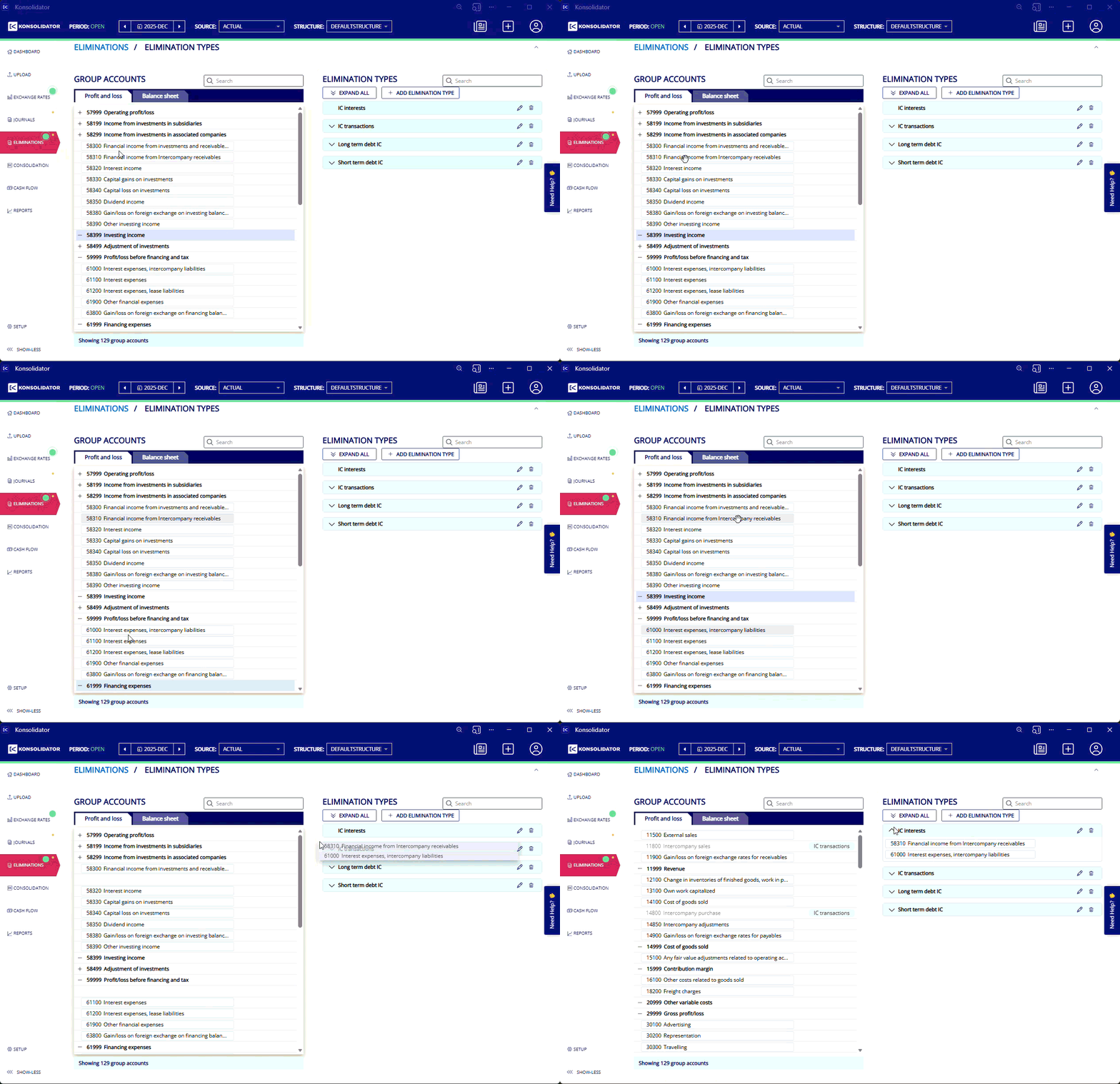
Adding the new intercompany group accounts will trigger the need for updating the Elimination types e.g. intercompany interests.
From the Elimination types section you identify your newly added intercompany accounts in the left-side panel and drag them to the related Elimination type in the right-side panel.
Cash flow
As a consequence of the IFRS 18 Presentation and Disclosure in Financial Statements an amendment to IAS 7 Statement of Cash Flows was made to change the starting point of the cash flow statement from Profit/loss to Operating profit/loss when preparing the statement of cash flows using the indirect method.
The implementation method for the cash flow is explained in detail for the specific implementation method chosen. Refer to the relevant articles for implementation by group structure or implementation by new environment.