
Please read the entire article before starting the implementation of IFRS 18 comparative figures.
This article is an 8 step guide on how to prepare your comparative figures for next financial year’s reporting compliant with IFRS 18, while preserving historically consolidated periods prepared in accordance with IAS 1 within the same environment.
The implementation of comparative figures by group structure is well suited for groups where the objective is to prepare the comparative figures including bridge adjustments required by IFRS 18.
For an initial introduction to the changes coming with IFRS 18, please refer to our article IFRS 18 in Konsolidator summarizing the changes from IAS 1 to IFRS 18 in brief as well as a side-by-side overview of our suggested implementation solutions.
When should you implement IFRS 18 by Group Structure?
To give a brief overview of the implementation process by group structure and how the different reporting requirements are met, we have summarized in a table and explained in further details below.
Table 1: Reporting requirements
| Reporting for year: | 2026 (IAS 1) | 2026 (IFRS 18) | 2027 (IFRS 18) |
| Group Structure | DEFAULTSTRUCTURE (IAS 1) | NEW IFRS 18 | NEW IFRS 18 |
| Purpose | IAS 1 reporting for 2026 including 2025 comparatives | IFRS 18 comparative figures for 2027 annual report | IFRS 18 reporting for 2027 |
| Reporting Standard | IAS 1 | IFRS 18 | IFRS 18 |
| Group CoA | IAS 1 (IFRS 18) | IFRS 18 (IAS 1) | IFRS 18 |
| Mapping of local accounts | IAS 1 | IAS 1 | IFRS 18 |
| Uploads | One upload per period | ||
| Journals | Original journals | Original journals (copy) + IFRS 18 journals | Ordinary journals |
| Calculate & Post | NO | YES | YES |
| Consolidation | Periods closed (unchanged) | Re-consolidate | Consolidate |
| Cash flow starting point | Differs | Operating profit/loss | Operating profit/loss |
| Subscription Tier | Enterprise Accounting | ||
Utilizing the group structure functionality allows the group to access your uploaded data and journals within the same environment. With a duplicated group structure, the uploads and mapping from 2026 are included in the new group structure and can be updated for IFRS 18 purposes with adjusting journals to move relevant income and expenses from IAS 1 group accounts to IFRS 18 relevant group accounts. These adjusting journals will represent the bridge adjustments required in the annual report disclosures for first year reporting under IFRS 18.
Before you start
- Subscription Tier required: Enterprise Accounting Tier
- Multiple Users: If multiple users have access, a clear guideline for the use of Konsolidator during the change is required. In general, we do not recommend by Group Structure approach for groups with multiple users.
- IFRS 18 group accounts: ensure the group accounts have been prepared as per article How to change Group Accounts in Konsolidator.
The By Structure approach requires a reconsolidation of 2026 and thus to open periods already consolidated for IAS 1 purposes. This puts you at risk of unintendedly changing the 2026 IAS 1 consolidations if, by mistake, work is performed in the IAS 1 structure. Therefore, we recommend careful consideration especially if multiple users have access to the environment.
Further the required level of detail of the IAS to IFRS 18 adjustments should be assessed by the group. The following should be considered in this assessment:
Table 2: Bridge adjustment considerations
| Consideration | RJE | EJE | YE only | All periods |
| 1) Comparative figures are only required for year-end reporting for group/subgroups | X | X | ||
| 2) Volatile multiple currencies relevant (if average rates for P&L consolidations are volatile and the effect is considered material within the year) | X | X | ||
| 3) Comparative figures are required for monthly/quarterly reporting | X | X | ||
| 4) IFRS reporting is relevant for all entities | X |
RJE=reclassification journal on entity level
EJE=elimination journal on group level
NB: Konsolidator will only guide you through the setup and preparation on how to adjust Konsolidator reporting going from IAS 1 to IFRS 18. The analysis of how to classify and report transactions according to IFRS 18 is to be assessed in a separate process by the group. The analysis will also support the groups in adjusting entries to be posted for IFRS 18 compliance.
Step 1: Add your new IFRS 18 group structure and add bridge dimension
After adding new IFRS 18 related accounts to your Group CoA (How to change Group Accounts in Konsolidator), a new group structure for the IFRS 18 reporting shall be created.
You can follow our community guide on how to create a new group structure here. We recommend naming the new structure IFRS 18.
In most cases, the current (IAS 1) group structure is named DEFAULTSTRUCTURE.
Dimension for bridge adjustment in case of IFRS 18 adjustments made at entity level: To isolate the adjustments made for the required bridge between IAS 1 to IFRS 18, at consolidated level, we recommend to create a dimension.
The dimension will not require a new dimension group but can be added to a current dimension group in use. If IFRS 18 adjustments are made as elimination journal entries (EJE) on group level at year end only, the bridge should appear from the EJE.
Figure 1 IFRS 18 bridge dimension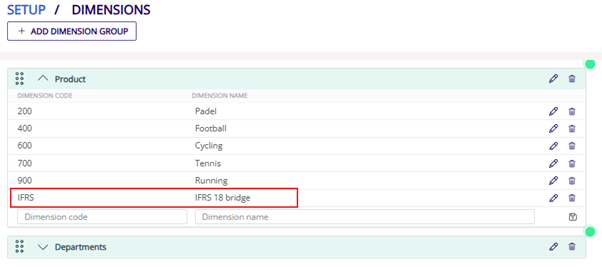
Step 2: Copy journals from IAS 1 reporting structure
With the new IFRS 18 group structure, you are now ready to copy your journals from the IAS 1 structure to the IFRS 18 structure.
As upload data is shared across all group structures, do not upload the trial balancesagain. Further, you need to ensure you have switched from the IAS 1 group structure to IFRS 18 structure.
To replicate your reporting historically, all historical journals shall be copied to the relevant period before further adjustments are prepared. This will ensure the IFRS 18 adjustments are prepared based on the IAS 1 reporting. You can read how to copy journals here.
Before moving to the next step ensure that all journals from the default structure are copied.
Step 3: Prepare the bridge adjustments from IAS 1 to IFRS 18
In multiple and volatile currency environments Konsolidator recommends preparing the bridge adjustments at entity level as a Reclassification Journal Entry (RJE) to ensure the correct exchange rate translations in all (relevant) periods in 2026. Elimination Journal Entries (EJE) are not considered for currency translation and the Elimination journals do not impact the cash flow statement.
If you have not yet tagged your IAS 1 group accounts, please go to our guide How to change Group Accounts in Konsolidator. Filter for the IAS 1 tag in the in-app upload report to identify IAS 1 balances for reclass.
The IAS 1 tagged account balances shall be cleared (adjusted to zero) by reclassification/elimination journal entries to the relevant IFRS 18 accounts. For later identification of the IAS 1 to IFRS 18 bridge, you have to mark all line items in the reclassification journal entries (RJE) with the bridge dimension.
Figure 2 Example: Financial items net, IAS 1 to IFRS 18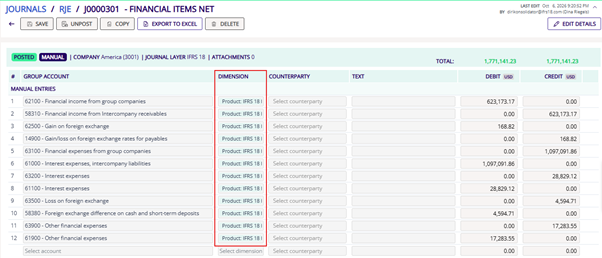
Some account balances can be reclassed directly from the IAS 1 account to the IFRS 18 account while other account balances will require splitting the amount (e.g. exchange rate differences) based on the group’s internal IFRS 18 analysis. If the amounts are uploaded on dimensions, these should also be considered for the reclassifications to avoid exchange rate effects. You can read more about how our foreign currency translations are calculated here.
In case the group needs to identify IAS 1 group account balances across several entities, it is possible to build a Konnect report utilizing the tags in the group account data (GA tab).
When all accounts balance tagged IAS1 are cleared, you are now ready to calculate & post to get the IFRS 18 consolidated P&L.
The following steps 4-6 are only relevant for groups using the cash flow feature in Konsolidator. Step 7 and 8 are relevant for all groups.
Step 4: Create new cash flow group accounts
With the IFRS 18 classification of income and expenses in the income statement, the income statement presentation moves closer to the cash flow presentation, being split into operating, investing, and financing activities.
As a result, in Konsolidator, you need to add new cash flow accounts for the cash flow presentation and map all new IFRS 18 group accounts created as part of How to change Group Accounts in Konsolidator. Read more about how to add new cash flow accounts here. For mapping of new accounts, refer to next step in this article.
Konsolidator recommendation: To retain a logic presentation of the cash flow statement, and present both financial income received and financial expenses paid as first line item in the cash flow from investing activities and cash flow from financing activities respectively, a renumbering of Proceeds and purchase of intangible assets and Proceeds and purchase of property, plant and equipment is required. Note the numbering of the cash flow accounts below is only the recommendation of Konsolidator and not mandatory.
Table 3: Renumbering cash flow accounts
| New cash flow account | Old cash flow account | Cash flow group account name |
| 3110 | 3010 | Proceeds from sale of intangible assets |
| 3120 | 3020 | Purchase of intangible assets |
| 3199 | 3099 | Proceeds and purchase of intangible assets, net |
| 3210 | 3110 | Proceeds from sale of property, plant and equipment |
| 3220 | 3120 | Purchase of property, plant and equipment |
| 3299 | 3199 | Proceeds and purchase of property, plant and equipment, net |
The following new cash flow accounts should be added:
Table 4: New cash flow accounts
| Cash flow group account | Cash flow group account name | Sum account |
| 3010 | Financial income received | 3099 |
| 3020 | Financial income received – intercompany | 3099 |
| 3099 | Financial income received | 3999 |
| 4010 | Financial expenses paid | 4099 |
| 4020 | Financial expenses paid – intercompany | 4099 |
| 4099 | Financial expenses paid | 4999 |
Step 5: Map P&L group accounts to cash flow
To calculate and consolidate the cash flow, all income statement and balance sheet accounts require mapping to the relevant cash flow accounts. You can read more about cash flow account mapping here.
It is important that you don’t change the cash flow mapping of the existing group accounts until you have calculated the final cash flow presentation for 2026 (before the IAS 7 amendment), as the cash flow mapping applies to all structures.
Based on the standard set of group accounts and the changes added as per our guide How to change Group Accounts in Konsolidator, we recommend the following mapping to the cash flow accounts:
Table 5: Mapping of new P&L group accounts to cash flow accounts
| Group account | Group account name | Cash flow account | Cash flow account name |
| 11900 | Gain/loss on foreign exchange rates for receivables | 1000 | Revenue |
| 14850 | Intercompany adjustments | 1010 | Cost |
| 14900 | Gain/loss on foreign exchange rates for payables | 1010 | Cost |
| Operating profit/loss | |||
| 58300 | Financial income from investments and receivables, which are non current assets | 3010 | Financial income received |
| 58310 | Financial income from Intercompany receivables | 3020 | Financial income received - intercompany |
| 58320 | Interest income | 3010 | Financial income received |
| 58330 | Dividend income | 3010 | Financial income received |
| 58380 | Foreign exchange difference on cash and short-term deposits | 3010 | Financial income received |
| 58390 | Other investing income | 3010 | Financial income received |
| 58400 | Gain from fair value adjustment of investment properties | 3430 | Improvements of investment properties |
| 58410 | Profit on sale of investment properties | 3410 | Proceeds from sale of investment properties |
| 58420 | Capital gains on investments | 3410 | Proceeds from sale of investment properties |
| 58430 | Impairment loss of other financial assets | 3720 | Acquisition of other financial investments |
| 58500 | Impairment loss of investment properties | 3420 | Purchase of investment properties |
| 58510 | Loss on sale of investment properties | 3410 | Proceeds from sale of investment properties |
| 58520 | Capital loss on investments | 3410 | Proceeds from sale of investment properties |
| Changes in investing income | |||
| 61000 | Interest expenses, intercompany liabilities | 4020 | Financial expenses paid – intercompany |
| 61100 | Interest expenses | 4010 | Financial expenses paid |
| 61200 | Interest expenses, lease liabilities | 4210 | Interest paid on lease liabilities |
| 61800 | Foreign exchange differences on interest-bearing loans and borrowings | 4120 | Repayment of borrowings |
| 61900 | Other financial expenses | 4010 | Financial expenses paid |
| 65000 | Fair value adjustment of mortgage debt | 4120 | Interest paid on lease liabilities |
| 65100 | Profit/loss on financial debts | 4120 | Interest paid on lease liabilities |
| Changes in financing income |
You are now ready to calculate & post your cash flow.
The following steps 5a and 5b are only relevant for entities preparing cash flow starting at profit after tax and entities preparing the IFRS 18 bridge adjustments as elimination journals. If your group’s cash flow starting point is before tax, jump to step 6.
Step 5a: Cash flow Adjusting journals (For entities preparing cash flow starting at profit after tax)
As a consequence of the new IFRS 18 standard, IAS 7 Statement of Cash Flows has been amended. The amendment requires entities to use the operating profit subtotal as the starting point for the cash flow from operating activities under the indirect method.
If the group as part of step 3 above, prepared the IFRS 18 adjustments as reclassification journals (RJEs), the newly added group accounts in the income statement and the cash flow mapping of the same accounts, will address most changes related to the IAS 7 amendment: All new investing and financing group accounts created are now mapped to the relevant investing and financing cash flow accounts as part of the previous step 5.
Since no new group accounts were created in the income statement for corporation tax income and expenses, the existing tax income and expense group accounts will remain mapped to 1080 Corporation tax for the year in the preparation of the comparative figures and in parallel of preparing the 2026 reporting.
As changes in the cash flow mapping of existing group accounts will affect all group structures (IAS 1 and IFRS 18), it is only possible to prepare the cash flow statement in accordance with the IAS 7 amendment by preparing cash flow adjustments (CFAs) or cash flow eliminations (CFEs) depending on the reporting requirements.
For the correct exchange rate translation, Konsolidator recommends CFAs at entity level.
Cash flow adjustment (entity level)
For cash flow adjustments on entity level, the system uses group accounts for the adjustment. Therefore, it’s important to know the group accounts mapped to 1080 Corporation tax for the year to make the adjustment. In our example, based on standard IFRS group account structure, the following group accounts are mapped to 1080 Corporation tax for the year:
Table 6: Group accounts mapped to cash flow group accounts
| Group account | Group account name | Cash flow account |
| 75100 | Current tax for the year | 1080 |
| 75200 | Deferred tax for the year | 1080 |
| 75300 | Adjustments recognised for tax from prior periods | 1080 |
| 75400 | Group contributions received | 1080 |
| 75500 | Group contributions paid | 1080 |
Any balances (movement) on the above-mentioned accounts should be reversed in a CFA journal. The offset account should be a group account mapped against cash flow account 2300 Income taxes paid/received in accordance with the IAS 7 amendment presentation requirement.
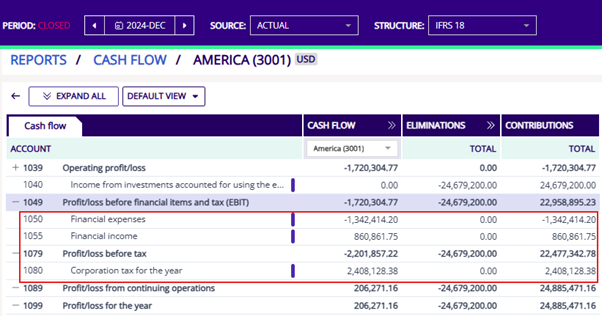
In our example, the movement currently presented as corporation tax for the year for entity America is total 2,408,128.38 USD:
Figure 3 Cash flow report for subsidiary America (IFRS 18 income statement adjusted by RJEs)
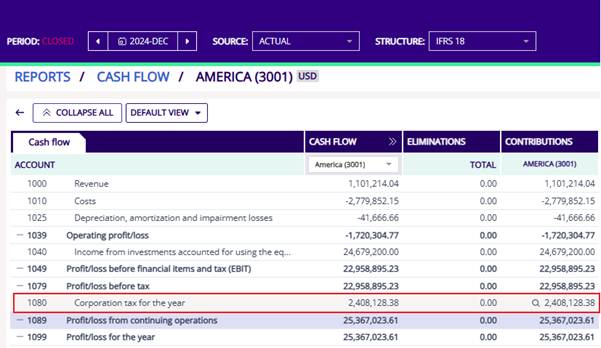
By clicking the magnifying glass, it is possible to see the group account movements summing up to the total amount for cash flow account 1080 corporation tax for the year (in local currency):
Figure 4 Details for cash flow account 1080 Corporation tax for the year
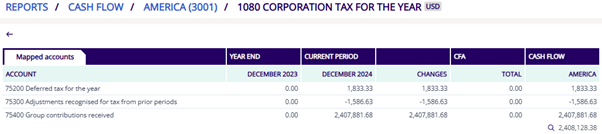
The total amount is reversed in a CFA journal as follows:
Figure 5 Cash flow adjusting journal for IAS 7 amendment related to IFRS 18
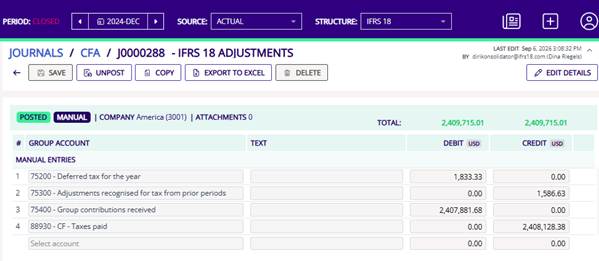
In our example we use group account 88930 – CF – Taxes paid as this account in our example is mapped to cash flow account 2300 Income taxes paid/received.
Once the Cash flow adjustment is posted, you can recalculate your cash flow with starting point at operating profit or loss.
Cash flow elimination (group level)
If the group has posted the IFRS 18 adjustments in step 3 as elimination journal entries (EJEs), these adjustments will not roll into the cash flow accounts and as such, any balances mapped to profit/loss for the year in the cash flow accounts needs to be reclassed to the correct relevant cash flow accounts.
Figure 6 Cash flow report for subsidiary America (IFRS 18 income statement adjusted by EJEs)
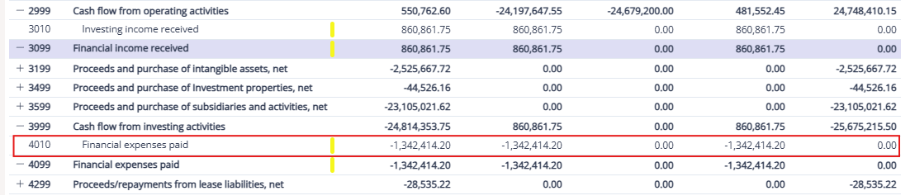
Cash flow eliminations are posted on the cash flow accounts with simple debit/credit postings. In this example we will focus on financial expenses of 1,342,414.20 USD on cash flow account 1050. If all balances are related to financing activities, the full amount can be reversed on cash flow account 1050 and posted against the new cash flow account for financial expenses paid:
Figure 7 Cash flow adjusted by cash flow eliminations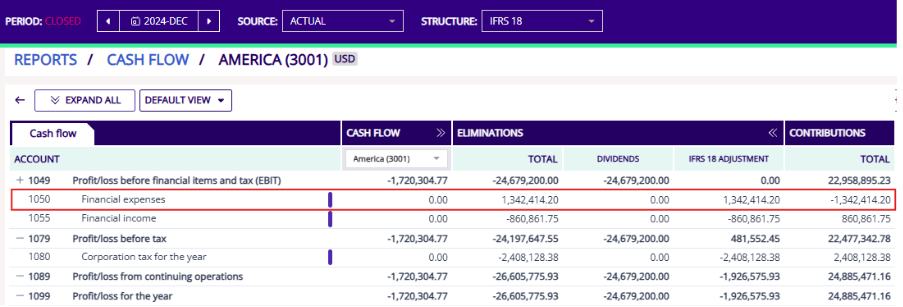
Step 5b: Update mapping of tax related accounts post year-end 2026 (For entities preparing cash flow starting at profit after tax)
After updating the mapping, it will not be possible to trace the cash flow mapping details (as shown in Figure 2 above) in historical periods.
As mentioned in step 5a above, the group accounts for financial income and expenses will not require remapping in the cash flow account mapping, as the new IFRS 18 group accounts have been created and mapped as part of step 3 above.
But as no new IFRS 18 group accounts were created for corporation taxes, these accounts require cash flow account remapping post completion of the 2026 financial statements.
Table 7: Remapping of corporation tax group accounts from cash flow account 1080
| Group account | Group account name | Cash flow account | New cash flow account |
| 75100 | Current tax for the year | 1080 | 2300 |
| 75200 | Deferred tax for the year | 1080 | 2300 |
| 75300 | Adjustments recognised for tax from prior periods | 1080 | 2300 |
| 75400 | Group contributions received | 1080 | 2300 |
| 75500 | Group contributions paid | 1080 | 2300 |
| Corporation tax |
Step 6: Change of cash flow account mapping (POST 2026 finalized)
The main purpose of the new IFRS 18 accounts created based on our guide How to change Group Accounts in Konsolidator, is to smoothen the transition and audit trail from upload to consolidated cash flow. However, system accounts are not duplicated, hence requires update of cash flow account mapping.
It is important not to change the cash flow mapping of the existing group accounts until the final cash flow presentation for 2026 (before the IAS 7 amendment) is calculated and final, as the cash flow mapping applies to all structures.
After updating the mapping, it will not be possible to trace the cash flow mapping details (as shown in Figure 2 above) in historical periods.
Below we have summarized the relevant system accounts with their current cash flow account mapping and the updated cash flow account mapping.
Table 8: Remapping of cash flow accounts
| Group account | Group account name | Cash flow account | New cash flow account |
| 58110 | Share of profit/loss from subsidiaries | 1040 | 3510 |
| 58120 | Amortization of goodwill | 1040 | 3510 |
| 58130 | Change in internal profits on inventories | 1040 | 3510 |
| 58140 | Dividend income | 1040 | 3530 |
| Income from investments in subsidiaries | |||
| 58210 | Share of profit/loss from associated companies | 1040 | 3610 |
| 58220 | Amortization of goodwill | 1040 | 3610 |
| 58230 | Dividend income | 1040 | 3630 |
| Income from investments in associates | |||
| 140310 | Depreciation at the beginning of the year | 1440 | 3430 |
| 140320 | Transfers from/(to) other items | 1440 | 3430 |
| 140330 | Exchange rate adjustments | 1440 | 3430 |
| 140340 | Depreciation for the year | 1440 | 3430 |
| 140350 | Depreciation reversed on disposals during the year | 1440 | 3430 |
| 140510 | Revaluations at the beginning of the year | 1440 | 3430 |
| 140520 | Transfers from/(to) other items | 1440 | 3430 |
| 140530 | Exchange rate adjustments | 1440 | 3430 |
| 140540 | Revaluations for the year | 1440 | 3430 |
Step 7: Disable IAS 1 group accounts
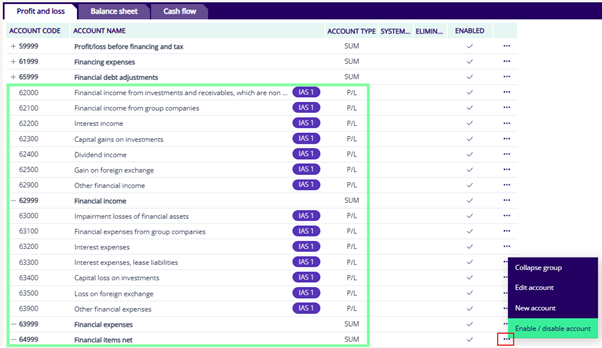
Once the comparative figures for the income statement have been prepared in the above steps - and the IAS 1 reporting is finalized - the IAS 1 related group accounts should be disabled to avoid future mapping or adjustments made to these accounts.
TIP: it is possible to disable multiple group accounts by disabling the related sum account but requires attention to the logic of the group account structure.
Figure 8 Disabling multiple group accounts
Step 8: Prepare IFRS 18 mapping of local accounts to group accounts
Despite the comparative figures being prepared based on the IAS 1 mapping of local accounts to group accounts, it is possible to prepare the IFRS 18 mapping of local accounts to group accounts by creating a new mapping:
Figure 9 Create new (IFRS 18) mapping of local accounts to group accounts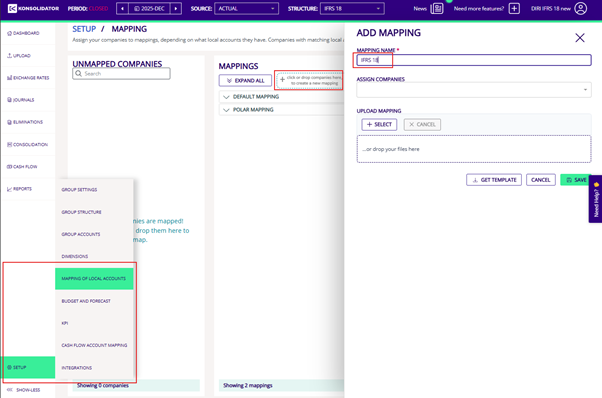
The mapping of local accounts to group accounts should include new local accounts created for the purpose of being compliant with IFRS 18 (e.g. exchange rate difference accounts) and change of mapping of existing accounts currently being mapped for presentation in accordance with IAS 1.
Once the last trial balance for financial year 2026 is uploaded, it is possible to change the mapping from current (IAS 1) to the new prepared mapping (IFRS 18). The change of mapping is easily done with the drag and drop functionality.